

The Subtle Body
The Subtle Body with Guy Donnahaye
The subtle body and the koshas are mentioned in Sutra 1.35 of the Patanjali Sutras.
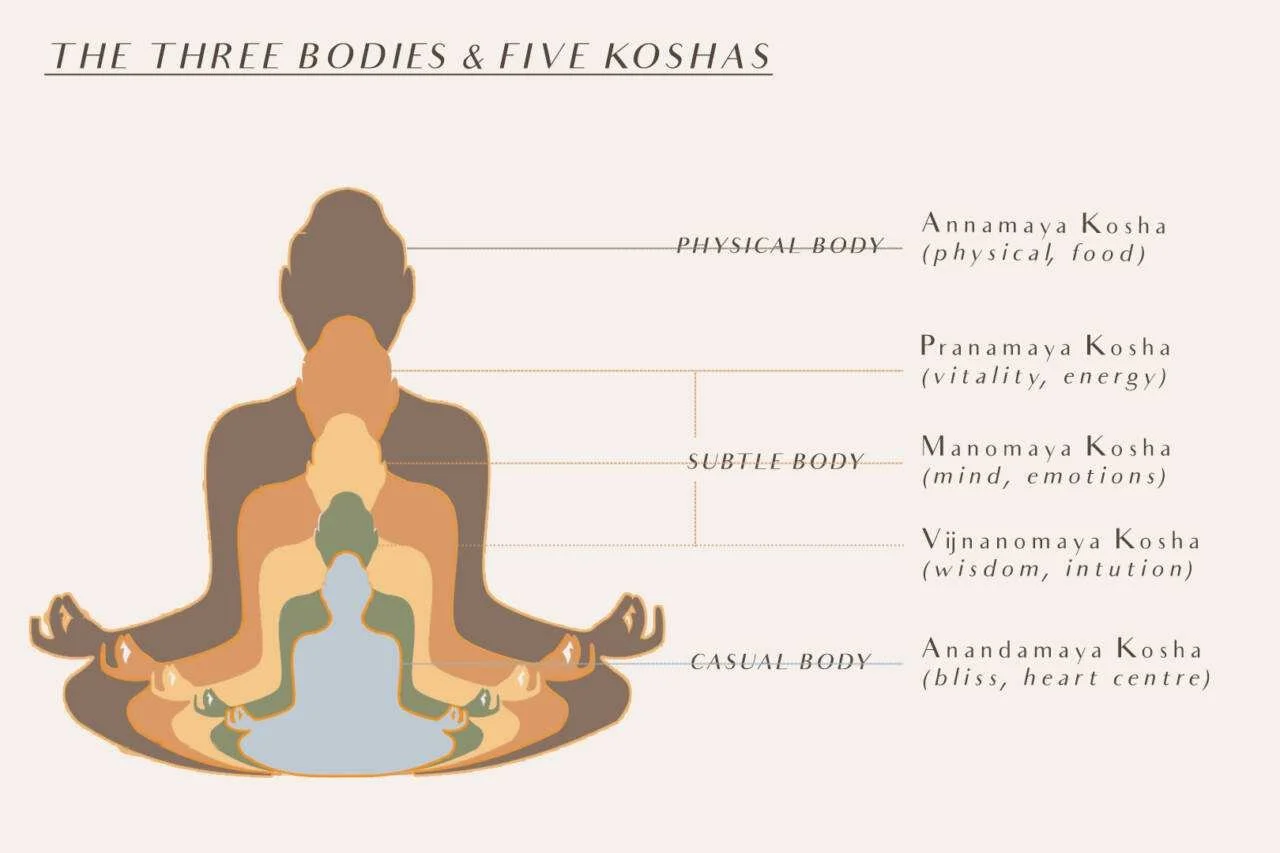
The Three Bodies and Five Koshas
In yogic philosophy, human beings are thought to possess three distinct bodies: the physical, the subtle (also known as the astral), and the causal (or karmic). These bodies encompass the Five Koshas, which are layers or sheaths: Annamaya, Pranamaya, Manomaya, Vijnanamaya, and Anandamaya.
Māyā - माया
Root Components "Ma" (to measure, to create) + "Ya" (that which is)
Various Translations: Illusion, deception, cosmic play
Pronunciation
Māyā [MAH-yah]
Māyā, derived from Sanskrit, translates to "illusion" or "that which is not." Within the realms of yoga and Vedantic philosophy, it describes the misleading aspect of reality, in which the world appears fragmented, fleeting, and constantly in flux. This concept serves as a force that conceals the true essence of existence, leading people to mistakenly perceive their identities as confined to their physical bodies, thoughts, and surroundings. To achieve self-realisation, it is crucial to overcome Māyā, enabling individuals to look past deceptions and recognise the eternal truth of Brahman, or ultimate reality.
Symbolism in Yoga Philosophy
Māyā is often represented as a dream, a mirage, or a cosmic play (Lila)—elements that seem real but dissipate under scrutiny. As a dream feels vivid until one wakes up, the world governed by Māyā appears solid until self-awareness reveals its transitory essence.
Māyā is frequently characterised as the illusion that causes minds to perceive separateness rather than oneness. It fosters attachment to ephemeral experiences, perpetuating the incorrect belief that the material world represents the ultimate truth.
Māyā in Vedānta and Yoga
Māyā is a fundamental principle within Hindu and yogic traditions.
In Advaita Vedānta, it acts as a veil obscuring the understanding that Brahman (universal consciousness) and Atman (the self) are intrinsically united.
In the Bhagavad Gita, Krishna describes māyā as composed of the three gunas (sattva, rajas, tamas), which shape our perceptions and attachments.
In Yoga, Māyā distracts the mind, resulting in suffering and reinforcing the false sense of self tied to the body and ego.
Practical Application
In Yoga Practice
Utilise meditation to observe thoughts as fleeting illusions rather than becoming attached to them.
Cultivate non-attachment (vairagya) by watching how desires and fears arise from conditioned perceptions.
Engage in self-inquiry (Jnana Yoga) by questioning what exists beyond temporary experiences.
In Daily Life
Acknowledge the fleeting nature of all experiences, joy and sorrow without clinging or resisting.
Enhance mindfulness by recognising how your perceptions shape emotions, conditioning, and beliefs.
Foster gratitude and presence, shifting the focus from illusion to more profound truths.
Quotes and Wisdom
"Māyā is like a veil over the truth; remove the veil, and reality shines."
"All that we see or seem is but a dream within a dream." — Edgar Allan Poe
Modern Relevance
Today, Māyā appears as societal conditioning, attachment to social standing, materialism, and the illusion of control. Many pursue happiness in external accomplishments, often overlooking their transience. By grasping the concept of māyā, individuals can liberate themselves from restrictive beliefs and align with more profound truths, leading to greater peace and enhanced self-awareness.
Related Concepts
Brahman: The ultimate reality that transcends māyā.
Vairagya: The principle of non-attachment, facilitating the ability to see through illusion and release clinging.
How to See Beyond Māyā
Mindset: Challenge ingrained beliefs and recognise that the external world is perpetually changing.
Actions: Participate in meditation, reflection, and study of yogic teachings to redirect awareness beyond illusion.
Reflection: Identify areas where māyā generates attachment or suffering and practice viewing beyond them.
Conclusion
Māyā represents the illusion that skews perception, causing individuals to believe in separation and transience. Recognising and moving past Māyā is vital for spiritual awakening, unveiling the unity of existence and the true self. One can dispel illusion and encounter ultimate reality through meditation, awareness, and self-reflection.
THE THREE BODIES:
PHYSICAL BODY
The physical body is the most tangible and includes elements such as flesh, bone, tissues, cells, molecules, and atoms. This body serves as a base for the other two bodies. It's the aspect of our being that people find most accessible, as it can be visually observed and physically felt daily. It interacts with the material world, and the first sheath, Annamaya, corresponds to this body.
SUBTLE (ASTRAL) BODY
The subtle body, often called the astral body, isn't visible to the untrained, yet it can be sensed through various methods. This body acts as an energetic model of the physical form and vibrates at a significantly higher frequency. It extends beyond what we perceive with our physical senses but can be accessed through many different healing practices. It comprises the subtle organs of action and includes the three koshas: Pranamaya, Manomaya, and Vijnanamaya.
THE CAUSAL BODY
The causal body is what imparts significance to the other two bodies. It embodies the subtlest vibration in human existence and represents the most expansive aspect of our nature. Unlike the other body, it does not serve as an energetic model of the physical. It lies beyond mind and consciousness and can only be truly understood through deep reflective practices like meditation. Often referred to as the soul, spirit, or Atman, it represents pure consciousness residing within us. This body is associated with the fifth kosha, Anandamaya (bliss).
THE FIVE KOSHAS
These five koshas, originating in the Taittiriya Upanishad, an ancient Tantric yoga text, are considered energetic layers that encase the soul. Engaging with and understanding these layers can draw an individual closer to a sense of unity with the universe and their true self.
"You are a multidimensional being. Your awareness spans various levels of existence. Through yoga, you understand and embrace all aspects of your being, from physical postures that tone the body to breath-control practices that enhance your life force, from meditation that calms the mind to acts of self-study and love that open you to profound wisdom and connection."
- Linda Johnsen, Yoga International
LAYER ONE: ANNAMAYA
The Annamaya kosha, meaning "made of food," is the outermost layer, serving as the sheath that nourishes the physical body and maintains the other koshas. This layer consists of all the tangible components of our mass, such as flesh, bones, and skin. It is essential in our lives, the first access point to deeper energy systems. Regular yoga enhances physical strength and flexibility, improves circulation and digestion, and fosters a connection to our physical self, aiding balance and grounding. This sheath is closely linked to the earth's elements.
Food intake - solids/liquids
Elimination
Asana
Ayurvedic doshas
Tnangeable
LAYER TWO: PRANAMAYA
The second sheath, Pranamaya, translates to "consisting of breath or life" and embodies the life force, or prana. This energy layer governs our vital biological functions, including breathing, digestion, and blood circulation. Known as Chi in Chinese medicine and Ka in ancient Egyptian traditions, it animates our bodies and minds, facilitating movement and self-expression. Practising pranayama, or breath control, helps connect us with this kosha, fostering a flow of life energy. This sheath corresponds with the water element.
Life force
Prana, Ojas, Tejas
Pranayama
Pranavayus;
Nadis - 72000
Chakras
Bandhas
Aura
LAYER THREE: MANOMAYA
The third kosha, Manomaya, means "body made of thought processes" and represents the mental sheath. This layer encompasses instinctive awareness, thoughts, and perceptions. While Western perspectives often attribute mental activities solely to the brain, yogic philosophy posits that the entire nervous system engages with this kosha. The mind sheath influences our worldview, with superficial thoughts and emotions resting atop more profound beliefs and values shaped by society and culture. Regular practice of mantra meditation can significantly enhance the health of the Manomaya kosha, helping to calm mental complexities. This kosha aligns with the fire element.
Mind
Gunas - Satvas, Rjasa, Tamas
Watching thoughts
Mantra
Kriya
Dharana - concentration
LAYER FOUR: VIJNANAMAYA
The fourth sheath, Vijnanamaya, meaning "the power of judgment or discernment," transcends the previous layers and is the seat of our intuitive wisdom. It serves as the observer aspect of our consciousness, allowing us to be aware of our thoughts and actions without being caught up in them. This kosha distinguishes humans from animals by enabling moral choices and self-direction, nurtured through practices of self-discipline and the precise observation of life events. An enriched Vijnanamaya kosha fosters more precise judgment, enhanced insight, and stronger willpower associated with the air element.
LAYER FIVE: ANANDAMAYA
The final kosha, Anandamaya, embodies spiritual bliss and is the deepest energy layer, often underdeveloped in many individuals. This kosha represents profound inner peace and joy, transcending the mind and emotions while encompassing them all. It reflects the essence of life's sweetness experienced during moments of mental stillness. While Anandamaya is present across all outer sheaths, it typically remains obscured by the distractions of daily consciousness. Practices involving mantra and meditation, particularly during relaxation phases following asana practice, can create connections to this blissful aspect of being. This kosha is associated with the ether element.
"In the study of Vedānta (Upanisads), the koshas are seen as veils that we are meant to explore, understand, and ultimately transcend, guiding us back to our true essence. These layers are intricately linked to various states of awareness (waking, dreaming, and sleeping) and our three bodies (gross, subtle, and causal). By understanding each kosha, from the densest to the more subtle, we can navigate our path toward oneness and deeper self-awareness."
Practice Reflection:
Sit quietly and notice the subtle hum of stillness within.
What remains when thought subsides? Can you feel peace that needs no reason?
Integrating the Koshas
The five koshas are not separate layers but interwoven expressions of consciousness.
They correspond to our states of awareness:
Waking (Jagrat): Annamaya and Pranamaya
Dreaming (Svapna): Manomaya
Deep Sleep (Sushupti): Vijnanamaya and Anandamaya
Through yoga, pranayama, meditation, and self-inquiry, we journey from the outermost sheath toward the innermost. As the veils of Māyā dissolve, the truth of Atman—the eternal Self—shines forth.
“The goal of life is to realize your inner Self, the Self of all beings.
Peel off the sheaths, layer by layer, and rest in that pure consciousness.”
— Swami Sivananda
Closing Reflection
Take a few moments of stillness.
Sense your body, your breath, your mind.
Recognize that each is a doorway inward.
As you move through your practice and your days, remember:
You are not the body, nor the breath, nor the mind—
You are the light that illumines them all.
“Through the knowledge of the five sheaths, one attains the knowledge of the Self.”
— Taittiriya Upanishad