
200 hrs Yoga TTC
Module 3
Yoga humanties
Ethics, yamas/niyamas, Yoga Alliance ethical code, inclusion & equity – 10 hrs
Overview
This 10-hour module grounds trainees in the ethical and philosophical foundations of yoga, as outlined in Patanjali’s Yoga Sutras. It explores how ancient yogic ethics—Yamas and Niyamas—integrate with modern standards of professionalism, inclusion, and equity, as defined by the Yoga Alliance Ethical Commitment.
Through reflective study, discussion, and experiential learning, trainees develop an embodied understanding of yoga’s moral code and how to translate it into teaching practice.
Learning Objectives
By the end of this module, trainees will be able to:
Understand and apply Yamas and Niyamas as guiding principles for ethical living and teaching.
Demonstrate knowledge of the Yoga Alliance Code of Conduct, Scope of Practice, and Equity Position Statement.
Recognize how inclusion, equity, and accessibility shape ethical teaching in diverse communities.
Reflect on personal values and how they align with the ethics of yoga.
Integrate ethical decision-making and compassionate communication into classroom and community interactions.
Content Outline
1. Yogic Foundations of Ethics (2 hours)
Study of Patanjali’s Yoga Sutras and the Eight Limbs of Yoga.
Exploration of the Yamas (restraints) and Niyamas (observances) as ethical guides:
Ahimsa (non-violence) – fostering kindness and non-harm.
Satya (truthfulness) – aligning thought, word, and action.
Asteya (non-stealing) – cultivating gratitude and generosity.
Brahmacharya (moderation) – practicing balance and restraint.
Aparigraha (non-possessiveness) – letting go of attachment and control.
Saucha (purity), Santosha (contentment), Tapas (self-discipline), Svadhyaya (self-study), Ishvara Pranidhana (surrender).
Reflective journaling and exercises from “Yamas and Niyamas in More Depth” to embody these principles.
2. Professional Ethics & Yoga Alliance Standards (2 hours)
Study of Yoga Alliance Ethical Commitment, including:
Scope of Practice
Code of Conduct
Equity Position Statement
Discussion of teacher–student boundaries, consent, integrity, and accountability.
Case studies exploring real-life ethical dilemmas in teaching and studio management.
3. Inclusion, Accessibility & Equity in Yoga (3 hours)
Understanding diversity and cultural awareness in the modern yoga landscape.
Language and cueing for accessibility and trauma-informed spaces.
Exploring bias, privilege, and representation in yoga culture.
Strategies for building inclusive and equitable learning environments.
4. Integration & Embodiment (3 hours)
Reflection circles: connecting ethical theory with personal experience.
Applying Yamas/Niyamas in teaching methodology, communication, and business ethics.
Journaling, peer dialogue, and guided meditation on integrity, service, and surrender.
Final integration project: “Ethics in Action” – trainees design a short teaching sequence or community initiative rooted in yogic ethics.
The kleshas
Understanding the Kleshas (Afflictions of the Mind)
As taught in the Yoga Sutras of Patanjali – Sutra 2.3
1. Introduction to the Kleshas
The word Klesha comes from the Sanskrit meaning pain, suffering, or affliction.
In yogic philosophy, the Kleshas are the root causes of all mental suffering and disturbed states of consciousness. According to Patanjali, they are the fundamental obstacles that keep the practitioner bound to ignorance, attachment, fear, and ego.
Patanjali identifies five main Kleshas in the Yoga Sutras (2.3):
Avidya, Asmita, Raga, Dvesha, Abhinivesha
These five afflictions shape our thoughts, emotions, behaviour, and karmic patterns.
2. The Five Kleshas Explained
1. Avidya – Ignorance
Avidya is the root of all other Kleshas. It is the misunderstanding of reality—mistaking the impermanent for permanent, the impure for pure, pain for pleasure, and the non-Self for the Self.
Examples:
Identifying only with the body and mind
Believing happiness comes solely from external objects
Forgetting our true nature as pure awareness
Impact in Life:
Avidya leads to wrong choices, suffering, and repeated negative patterns.
2. Asmita – Egoism (I-ness)
Asmita is the false identification of the Self with the ego, intellect, or roles we play. It is the sense of “I am this.”
Examples:
“I am only my profession”
“I am better than others”
Strong identification with opinions and personal image
Impact in Life:
Creates pride, comparisons, separation, and conflict.
3. Raga – Attachment
Raga is an emotional attachment to pleasure and desirable experiences. It is the craving to repeat what once brought happiness.
Examples:
Clinging to relationships, comfort, success, or material objects
Addiction to pleasurable sensations
Impact in Life:
Creates dependency, disappointment, and fear of loss.
4. Dvesha – Aversion
Dvesha is repulsion or avoidance toward pain or unpleasant experiences. It develops from past suffering.
Examples:
Avoiding certain people or situations
Strong dislike, resentment, or hatred
Impact in Life:
Keeps the mind reactive, defensive, and trapped in negativity.
5. Abhinivesha – Fear of Death / Clinging to Life
Abhinivesha is the deep-rooted instinctive fear of death and strong attachment to life, present even in the wise.
Examples:
Fear of ageing
Fear of change
Fear of losing identity or control
Impact in Life:
Creates anxiety, insecurity, and resistance to transformation.
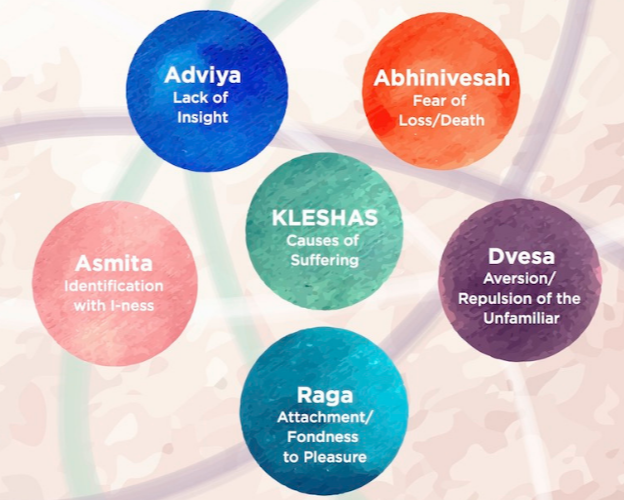
. The Relationship Between the Kleshas
Avidya is the mother of all Kleshas.
From ignorance arises Asmita (ego).
From the ego arise Raga (attachment) and Dvesha (aversion).
All four together reinforce Abhinivesha (fear of death).
Thus, the Kleshas form a cycle of suffering that keeps the practitioner bound to Samsara (repetitive suffering).
4. The Kleshas and Daily Life
The Kleshas manifest as:
Emotional reactivity
Relationship conflicts
Repetitive negative habits
Fear, anxiety, jealousy, anger
Attachment and insecurity
Understanding the Kleshas helps the yoga practitioner move from unconscious reactions to conscious awareness and freedom.
5. How Yoga Helps in Reducing the Kleshas
Patanjali offers several tools to weaken and overcome the Kleshas:
Abhyasa (Regular Practice) – consistent yoga, meditation, and self-study
Vairagya (Detachment) – letting go of excessive attachment and aversion
Kriya Yoga (Tapas, Svadhyaya, Ishvara Pranidhana)
Asana – stabilises the body and nervous system
Pranayama – purifies the mind and emotions
Dhyana (Meditation) – brings awareness to subconscious patterns
Viveka (Discrimination) – discerning the real from the unreal
With sustained practice, the Kleshas gradually weaken and lose their power over the mind.
Relationship Between Kleśas and Guṇas
The kleśas are the psychological roots of suffering, while the guṇas are the energetic qualities of nature that influence our inner state.
When tamas and rajas dominate, the kleśas thrive — ignorance, craving, and aversion increase.
As sattva rises through yoga practice, clarity dawns, avidyā (ignorance) fades, and the natural radiance of puruṣa is revealed.