
200 hrs Yoga TTC
Module 1
Techniques, Training & Practice (75hrs)
The 5 Vayus
he Five Prāṇa Vāyus: Pathways of Vital Energ
In yogic philosophy, Prāṇa is the universal life force that animates all beings — the bridge between body, mind, and spirit.
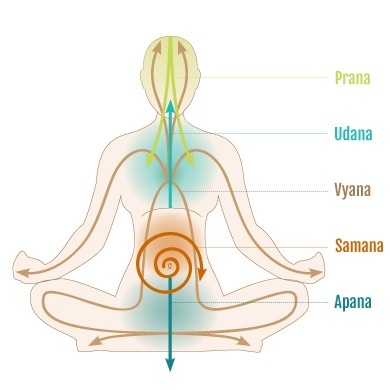
Within the subtle body (sūkṣma śarīra), prāṇa flows through channels (nāḍīs) and organizes itself into five primary directional currents known as the Pañcha Prāṇa Vāyus — the five winds or vital airs.
Each vayu governs a distinct movement of energy and a set of physiological and psychological functions. Together, they sustain life and consciousness, much as the five elements sustain the physical world.
The Upaniṣads – The Birth of the Five Winds
The Praśna Upaniṣad (3.3–3.8) first names and describes the five vāyus:
“Prāṇa verily is the life of all beings… From this prāṇa are born the other prāṇas — Apāna, Samāna, Udāna, and Vyāna — each performing its own function in the body.”
Here, Prāṇa is seen as the chief life force, from which all other vāyus arise — each governing a different movement and aspect of life. This teaching roots the concept of the vāyus in the ancient realization that consciousness moves as energy within form.
The Bhagavad Gītā – The Yoga of Equilibrium
In Bhagavad Gītā 4.29, Krishna describes yogic control of breath:
“Others offer prāṇa into apāna, and apāna into prāṇa, restraining the courses of prāṇa and apāna, intent on prāṇāyāma.”
This verse symbolizes the union of upward and downward forces, leading to inner steadiness — the essence of Samāna Vāyu, which harmonizes all dual movements.
Patañjali’s Yoga Sūtras – Mastery of Prāṇa and Mind
While the Yoga Sūtras do not explicitly name all five vāyus, Patañjali describes their mastery through prāṇāyāma and saṃyama:
II.49–53 – “Prāṇāyāma is the cessation of the movement of inhalation and exhalation.”
→ The gati (movement) refers to the control of the vāyus. When they are balanced, the mind becomes still and luminous.III.40 – “Through mastery of Udāna, one becomes unaffected by water, mud, or thorns, and can leave the body at will.”
→ Points directly to Udāna Vāyu, the upward current that enables transcendence and resilience.III.41 – “Through mastery of Samāna comes the radiance of inner fire.”
→ Refers to Samāna Vāyu, governing digestion, assimilation, and the awakening of inner brilliance (tejas).
The Haṭha Yoga Pradīpikā
Haṭha Yoga Pradīpikā (2.2) states: “When prāṇa moves, mind moves; when prāṇa is still, mind is still.”
Control of vāyus through bandha, mudrā, and prāṇāyāma is essential to awakening kuṇḍalinī.
1. Prana Vayu – The Inward and Upward Moving Energy
Location: Chest, heart, lungs, upper thoracic region
Direction of Movement: Inward and upward
Elemental Quality: Air
Primary Function: Receiving and intake
Functions of Prana Vayu
Prana Vayu governs:
Inhalation and the intake of breath
Oxygenation and circulation in the upper body
Sensory perception (seeing, hearing, tasting)
Mental alertness and clarity
The flow of energy to the brain and heart
The ability to receive — breath, food, impressions, and experiences
On a psychological level, Prana Vayu is associated with openness, inspiration, motivation, and presence. When balanced, we feel uplifted, alert, and receptive. When disturbed, it can manifest as anxiety, shallow breathing, fatigue, or lack of inspiration.
Pranayama to Work with Prana Vayu: Full Yogic Breath (Dirga Pranayama)
This breath emphasises deep, conscious inhalation, directly nourishing Prana Vayu.
How to Practice:
Sit comfortably with the spine upright.
Inhale slowly into the belly.
Continue inhaling into the ribs.
Fill the upper chest and collarbones.
Exhale smoothly from chest → ribs → belly.
Repeat for 10–15 slow rounds.
Energetic Effect:
Enhances the upward flow of energy, increases oxygenation, calms the nervous system, and strengthens the receptive quality of the breath.
2. Apana Vayu – The Downward and Outward Moving Energy
Location: Lower abdomen, pelvis, genitals, anus
Direction of Movement: Downward and outward
Elemental Quality: Earth
Primary Function: Elimination and release
Functions of Apana Vayu
Apana Vayu governs:
Exhalation (as release)
Elimination of urine, faeces, and toxins
Menstruation and reproduction
Childbirth
Grounding and stability
The ability to let go physically and emotionally
Psychologically, Apana Vayu supports trust, grounding, and the ability to release what no longer serves. When balanced, one feels stable and rooted. When disturbed, it may result in constipation, anxiety, fear, or lack of grounding.
Pranayama to Work with Apana Vayu: Extended Exhalation Breathing
Lengthening the exhale encourages release and downward flow.
How to Practice:
Inhale for a count of 4.
Exhale slowly for a count of 6–8.
Let the belly gently draw inward on the exhale.
Continue for 2–5 minutes.
Energetic Effect:
Stimulates elimination, calms the nervous system, enhances grounding, and supports physical and emotional detoxification.
3. Samana Vayu – The Balancing and Integrating Energy
Location: Navel centre, digestive organs
Direction of Movement: Inward and outward from the centre
Elemental Quality: Fire
Primary Function: Digestion and assimilation
Functions of Samana Vayu
Samana Vayu governs:
Digestion of food and absorption of nutrients
Metabolism and digestive fire (agni)
Assimilation of sensory and life experiences
Balance between Prana and Apana
Emotional processing and inner equilibrium
When Samana Vayu is balanced, digestion is strong, the mind is clear, and experiences are properly integrated. When disturbed, it can show up as poor digestion, bloating, sluggish metabolism, or mental overwhelm.
Pranayama to Work with Samana Vayu: Kapalabhati (Skull Shining Breath)
This is a heating and activating pranayama that directly stimulates the navel centre.
How to Practice:
Sit tall with hands on knees.
Take a deep inhale.
Begin with short, forceful nose exhales, snapping the belly inward.
Let the inhales happen passively.
Start with 20–30 rounds, rest, and repeat 2–3 times.
Energetic Effect:
Strengthens digestive fire, clears stagnant energy from the abdomen, and enhances assimilation at physical and energetic levels.
4. Udana Vayu – The Upward Moving Energy of Expression and Growth
Location: Throat, neck, head, brain
Direction of Movement: Upward
Elemental Quality: Ether
Primary Function: Expression and upward expansion
Functions of Udana Vayu
Udana Vayu governs:
Speech and communication
Growth of the body
Memory and cognition
Willpower and effort
The upward movement of consciousness
Spiritual evolution and awakening
When balanced, Udana Vayu supports clear communication, confidence, and spiritual insight. When disturbed, it may lead to confusion, speech issues, lack of direction, or weak willpower.
Pranayama to Work with Udana Vayu: Ujjayi Pranayama
This breath focuses attention on the throat and promotes upward energy flow.
How to Practice:
Slightly constrict the throat as if fogging a mirror.
Inhale and exhale through the nose with a soft oceanic sound.
Keep the throat relaxed yet toned.
Continue for 3–5 minutes.
Energetic Effect:
Activates the throat centre, enhances mental clarity, strengthens the upward movement of consciousness, and supports expressive power.
5. Vyana Vayu – The Expansive, Circulatory Energy
Location: Entire body, especially the limbs
Direction of Movement: Outward, circulating
Elemental Quality: Water
Primary Function: Circulation and integration
Functions of Vyana Vayu
Vyana Vayu governs:
Circulation of blood, lymph, and energy
Coordination of movement
Nervous system communication
Distribution of prana to all systems
Integration of all other vayus
When balanced, the body feels connected, coordinated, and vital. When disturbed, it can lead to poor circulation, numbness, restlessness, or a lack of embodied awareness.